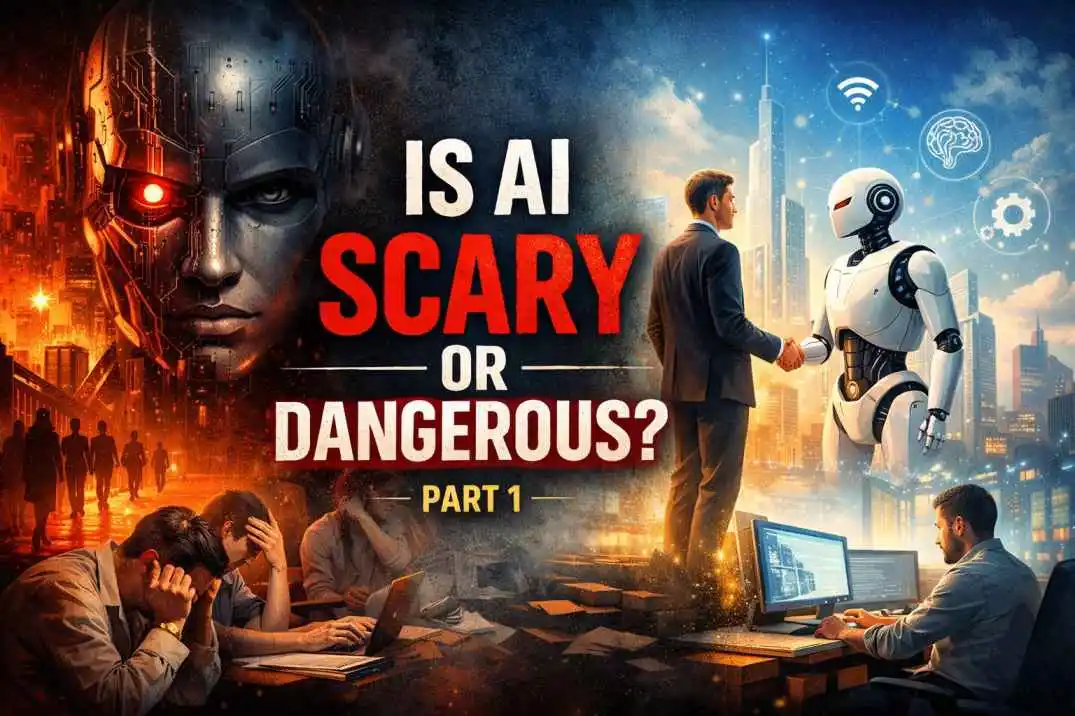
Introduction: The Question Everyone Is Afraid to Ask
Is AI scary?
Is it dangerous?
Or is it just… misunderstood?
Every time you open LinkedIn, there’s a new headline:
“Company lays off 1,000 employees due to AI adoption”
“AI replaces junior developers”
“This job won’t exist in 5 years”
And silently, a question forms in many minds:
“Am I next?”
Before we panic—or celebrate—let’s slow down.
Because every revolution feels scary when you’re standing inside it.
Steam engines were scary.
Electricity was scary.
Computers were scary.
The internet was terrifying.
Yet here we are.
AI is not the first revolution.
But it might be the fastest one we’ve ever experienced.
WHY: Why Is AI Suddenly Everywhere?
AI didn’t appear overnight.
It was quietly learning for decades.
So why does it feel explosive now?
Three reasons:
1. Data Explosion
Every click, post, purchase, photo, message—data is fuel for AI.
The world finally has enough data to make AI useful.
2. Computing Power Became Cheap
What once required supercomputers now runs in the cloud.
Scale is no longer a luxury—it’s standard.
3. Better Algorithms
Smarter models + faster training = practical AI.
AI didn’t suddenly become intelligent.
We finally built the environment for it to work.
WHAT: What Is AI — Really? (No Hype, No Fear)
Let’s strip away the buzzwords.
AI is not consciousness.
AI is not human intelligence.
AI does not “think” like us.
At its core:
AI is pattern recognition at scale.
It learns by:
Observing data
Finding patterns
Predicting outcomes
That’s it.
When you use tools like OpenAI, Google, or Microsoft, you’re interacting with systems trained on massive historical data not intelligence with intent.
AI doesn’t understand meaning.
It understands probability.
And that distinction matters a lot.
HOW: How Does AI Actually Work Behind the Scenes?
Let’s break this down simply.
Step 1: Data In
Text, images, videos, numbers huge volumes.
Step 2: Training
The model adjusts billions of parameters to reduce errors.
Step 3: Prediction
Based on past patterns, it predicts the most likely next output.
That’s why AI feels smart.
It’s extremely good at predicting what usually comes next.
But here’s the truth many don’t say:
AI is powerful, but fragile.
It depends entirely on data quality, human intent, and usage context.
The World of AI Today: Who’s Driving This Change?
AI is no longer a lab experiment.
It’s shaping real lives.
Companies pushing this evolution include:
OpenAI – democratizing AI access
NVIDIA – powering AI hardware
Meta – AI in social and creativity
Amazon – AI in logistics and cloud
AI today:
Helps doctors detect diseases earlier
Assists developers write and review code
Optimizes supply chains
Enhances creativity instead of killing it
This is not science fiction.
This is daily life.
Before AI vs After AI: What Actually Changed?
Before AI
Manual repetition
Slower decision-making
Experience-driven guesses
Human bottlenecks everywhere
After AI
Automation of routine tasks
Faster insights
Data-backed decisions
Humans move toward judgment, not execution
AI didn’t remove work.
It shifted the nature of work.
The Layoff Fear: Let’s Talk Honestly
Yes—layoffs are happening.
But let’s ask the real question:
Is AI replacing people… or inefficient systems?
Historically:
Typists disappeared → editors emerged
Manual accountants declined → financial analysts grew
Factory labor reduced → system operators increased
AI replaces:
Repetitive roles
Predictable workflows
Non-adaptive skill sets
AI does not replace:
Critical thinking
Context awareness
Creativity with intent
Problem framing
AI replaces those who refuse to adapt.
That’s uncomfortable but honest.
Revolutions Always Follow the Same Pattern
Every decade, something shifts.
Industrial Revolution → Machines
Digital Revolution → Computers
Internet Revolution → Connectivity
Now:
AI Revolution → Intelligence at scale
Each revolution:
Breaks old jobs
Creates new ones
Rewards early learners
Punishes complacency
AI is no different just faster.
Change Is the Only Constant
This is the uncomfortable truth:
If you don’t take AI seriously, AI will definitely replace you.
Not because it’s evil.
But because someone else learned how to use it better than you.
The danger is not AI.
The danger is ignoring it.
Solutions: How Should People Adapt?
Especially for young professionals and software engineers:
1. Learn How AI Thinks
Not tools. Fundamentals.
2. Use AI as a Co-Pilot
Not a replacement. An amplifier.
3. Upgrade Thinking, Not Just Skills
Frameworks > Syntax.
4. Stay Curious, Not Defensive
Curiosity always wins long-term.
5. Build Judgment
AI gives answers. Humans ask the right questions.
Confidence for the Future
This is not the end of careers.
This is the beginning of better ones.
AI will not replace you.
But someone using AI might.
And that’s not a threat.
That’s an invitation.
Ending Note (Part 1 Closure)
AI feels scary because it’s new.
Every revolution felt the same.
The real question is not:
“Will AI change the world?”
It already has.
The real question is:
“Will you change with it?”
This is Part 1.
In the next parts, we’ll go deeper into jobs, ethics, real skills, and survival strategies.
Stay tuned. The revolution has just begun.