When we think of social networks, we usually think of dopamine hits: the viral TikTok video, the Instagram reel, or the heated debate on X (formerly Twitter). But there is one giant that sits quietly in the corner of the internet, ignoring the noise, generating billions in revenue, and mapping the entire global economy.
That giant is LinkedIn.
To the average user, LinkedIn is just a place to update a resume or hunt for a job. But to a software engineer or a product strategist, LinkedIn is a masterpiece of system design and business modeling. It is not just a social network; it is the world’s first Professional Identity Graph.
In this detailed breakdown, we are going to tear apart the engine. We will look at its history (from a living room in 2002 to a Microsoft acquisition), its architectural brilliance (how they invented the tech that runs modern Silicon Valley), and the genius business model that makes it unique among tech giants.
Part 1: The Origin Story (2002–2006)
The "PayPal Mafia" Connection
To understand LinkedIn, you have to understand its primary architect: Reid Hoffman.
In the early 2000s, the tech world was in ruins. The Dot-Com bubble had burst, wiping out billions of dollars. But amidst the wreckage, a group of former PayPal executives known famously as the "PayPal Mafia" were plotting the next wave of the internet. While Elon Musk went on to build Tesla and SpaceX, and Peter Thiel went into venture capital, Reid Hoffman became obsessed with a different problem: How do humans connect economically?
Hoffman had a background in philosophy from Oxford and had previously founded a failed dating site called SocialNet. He realized that people didn't just need to "socialize" online; they needed to build "career leverage."
The Living Room Launch
In December 2002, Hoffman gathered a team of old colleagues, Allen Blue, Konstantin Guericke, Eric Ly, and Jean-Luc Vaillant, in his living room. They weren't building a fun app. They were building a utility.
On May 5, 2003, LinkedIn officially launched.
The "Cold Start" Struggle
Growth was painful. In the era of viral growth, LinkedIn was a slow burn.
Month 1: They had roughly 4,500 users.
Daily Growth: On some days, fewer than 20 people signed up.
Hoffman famously calculated that for the search functionality to be useful, they needed 1 million users. This was their "Cold Start Problem." A network is useless without people, but people won't join a useless network.
They solved this not with marketing, but with a feature: Contact Importing. By allowing users to upload their address books, they triggered a viral loop. If one high-value professional joined, they invited their colleagues. By 2004, they hit that magic 1 million user mark. By 2006, unlike many of its peers, LinkedIn turned its first profit.
Part 2: What LinkedIn Actually Is (The Core Product)
If you ask a layman, they will say LinkedIn is "Facebook for work." They are wrong.
From an engineering and product perspective, LinkedIn is a Structured Knowledge Graph.
While Facebook maps social connections (friends, family), LinkedIn maps economic entities. This is what they call The Economic Graph.
It consists of nodes and edges:
Nodes: Members, Companies, Jobs, Skills, Schools, Knowledge.
Edges: "Employed by," "Skilled in," "Alumni of," "Connected to."
This structure is why LinkedIn won. Facebook connects you to people you already know and like. LinkedIn connects you to people you should know to advance your economic standing. This data—your verified skills, your work history, your network—is the "moat" that protects LinkedIn. No other company has this historical career data.
Part 3: The Business Model (How It Prints Money)
This is where LinkedIn is a stroke of genius. Most social networks (Instagram, TikTok, YouTube) rely 90-99% on advertising. This makes the user the product.
LinkedIn is different. It is a SaaS (Software as a Service) company disguised as a social network. It has a diversified, three-pronged revenue engine:
1. Talent Solutions (~60% of Revenue)
This is the cash cow. LinkedIn realized early on that the people with the most money weren't the job seekers—it was the recruiters.
The Product: LinkedIn Recruiter. It allows HR teams to search the entire database of global professionals, even those who aren't looking for jobs (passive candidates). Companies pay thousands of dollars per seat for this access.
Why it works: It digitizes the headhunting industry.
2. Marketing Solutions (~25% of Revenue)
This is the advertising arm, but with a twist.
If you sell a generic shoe, you advertise on Facebook.
If you sell a $50,000 enterprise software package, you advertise on LinkedIn.
Why? Because LinkedIn provides Contextual Targeting. An advertiser can say: "Show this ad only to CTOs in the Finance industry with 10+ years of experience." This high-quality targeting commands massive ad rates.
3. Premium Subscriptions (~15% of Revenue)
This is what you and I see.
Premium Career: For job seekers who want to see who viewed their profile.
Sales Navigator: A powerful tool for salespeople to find leads and decision-makers at target companies.
LinkedIn Learning: Born from the acquisition of Lynda.com, this sells upskilling courses to enterprises.
Part 4: System Design & Tech Stack
For the engineers reading this, LinkedIn’s contribution to open-source technology is legendary. They didn't just use tools; they invented them because the tools they needed didn't exist.
1. Apache Kafka (The Nervous System)
In the early days, LinkedIn had a "spaghetti code" problem. They had to move massive amounts of data (clicks, profile updates, messages) between different systems.
The Invention: LinkedIn’s engineering team created Apache Kafka.
What it is: A high-throughput, distributed messaging system. Think of it as the central nervous system of the company. Every event that happens on LinkedIn is a "message" sent through Kafka to be consumed by other services (search, newsfeed, security). Today, 80% of the Fortune 100 use Kafka.
2. Espresso (The Memory)
Standard SQL databases couldn't handle the scale of LinkedIn’s document-based data.
The Solution: They built Espresso, a distributed NoSQL document store. When you load your profile or your inbox, you are likely pulling data from Espresso. It provides high availability and massive scalability.
3. The Feed Algorithm (AI & Machine Learning)
LinkedIn’s feed is unique. On TikTok, the algorithm optimizes for "Time Spent" (addiction). On Facebook, it optimizes for "Reactions" (engagement).
The LinkedIn Metric: They optimize for "Knowledge Value."
The algorithm uses a mix of "Dwell Time" (how long you spend reading a post) and "People You Know" signals. It actively tries to suppress viral, low-quality content in favor of niche, professional knowledge. It uses Transformer-based models (like the "T" in GPT) to understand the semantic context of posts.
Part 5: The Microsoft Era (2016 – Present)
In 2016, the tech world shook. Microsoft acquired LinkedIn for $26.2 Billion in an all-cash deal.
Why?
Microsoft owns the Office Graph (Outlook, Word, Teams—how you work). LinkedIn owns the Professional Graph (Who you know, what you know).
By combining them, Microsoft created an ecosystem where your professional identity connects seamlessly with your productivity tools. Today, LinkedIn operates relatively independently but benefits from Microsoft's massive AI infrastructure (Azure and OpenAI partnerships).
Current Stats (2024/2025):
Users: 1 Billion+ members.
Revenue: Run rate approaching $20 Billion+.
Offices: Headquartered in Sunnyvale, CA, with major hubs in Bangalore, Dublin, and New York.
Part 6: Engineering Lessons from LinkedIn
If you are building a product, here are the key takeaways from LinkedIn’s success:
Solve the Hardest Problem First: LinkedIn solved the "Identity" problem before they solved the "Content" problem. By getting people to upload their resumes, they created a high-switching-cost asset.
Monetize the Value, Not the User: They didn't charge the users for basic access; they charged the companies who extracted value from those users.
Infrastructure is Innovation: Sometimes, the product you are building is too advanced for current technology. Like LinkedIn with Kafka, you might need to build your own tools.
The "Tour of Duty" Culture: LinkedIn’s internal HR philosophy is that employment is a transaction. They don't expect employees to stay forever. They expect a "Tour of Duty"—you give the company your best work for 2-4 years, and the company increases your market value for your next job.
Here is the detailed "Part 7: Behind the Scenes – System Design Architecture" that you can add to your blog. I have written it in the same professional, "masterclass" tone.
Since I cannot generate an image directly, I have created a Text-Based Architectural Diagram below. You can use tools like Mermaid.js, Draw.io, or Excalidraw to recreate this visual for your blog. It will look very professional.
Part 7: Behind the Scenes – System Design Architecture
To truly understand LinkedIn, we must look at the "plumbing." LinkedIn’s architecture is a massive, distributed system composed of over 1,000+ microservices.
Here is the flow of data when a user interacts with the platform.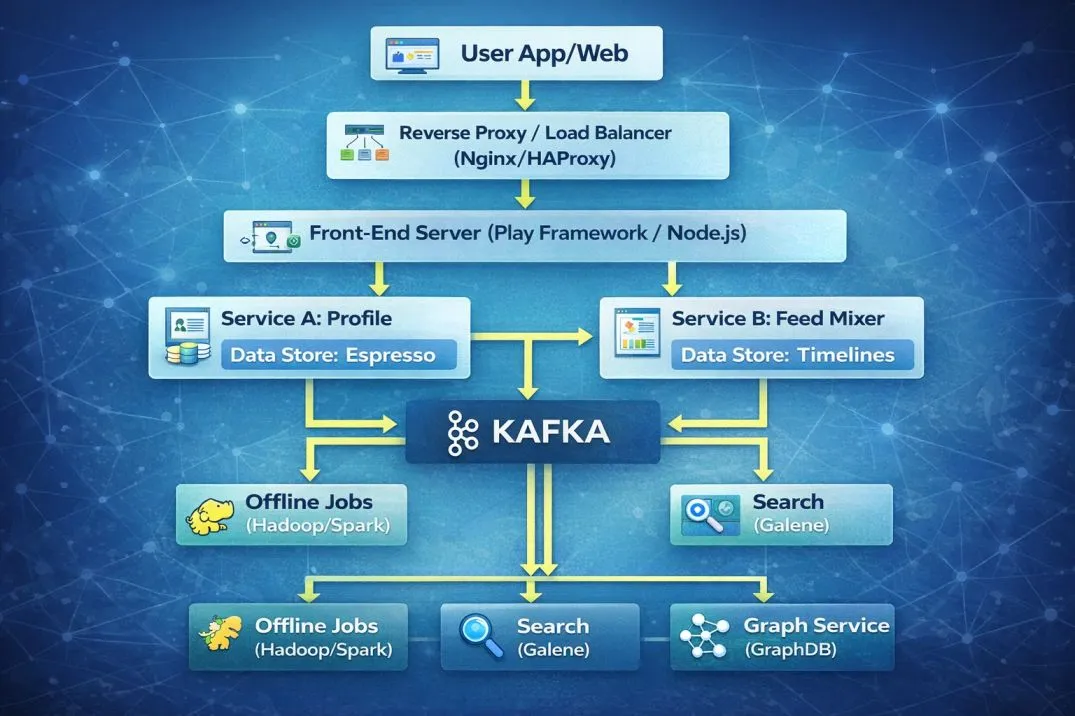 LinkedIn’s architecture relies on three pillars that they built in-house because existing tools weren't good enough.
A. Apache Kafka (The Heartbeat)
Role: The Central Nervous System.
How it works: Kafka is a "distributed commit log." Every single action you take—clicking a profile, liking a post, updating a job—is a "message."
The Flow: When you "Like" a post, the Front-End doesn't write directly to the database. It sends a message to Kafka. Kafka then "streams" this message to multiple places instantly:
To the Notification Service (to tell the author).
To the Analytics Service (to track engagement).
To the Feed Service (to update the like count).
Why: This decouples systems. If the Analytics service crashes, the User doesn't see an error. Kafka just holds the message until Analytics comes back online.
B. Espresso (The Memory)
Role: The Primary Database.
Technology: A distributed, document-oriented NoSQL database.
How it works: Unlike SQL databases (like MySQL) which are rigid, Espresso stores data as "documents." This is perfect for a LinkedIn profile, which has nested data (Experience -> Job 1, Job 2; Education -> School A, School B).
Scale: It serves millions of reads per second. When you edit your profile, you are writing to Espresso.
C. Rest.li (The Language)
Role: The Communication Protocol.
How it works: With 1,000+ microservices, Service A (Messaging) needs to talk to Service B (Profiles) without breaking things. Rest.li is a framework that forces strict data models. It ensures that if the Profile team changes their code, the Messaging team’s code doesn't crash.
2. Deep Dive: How the "Feed" Works (The "Feed Mixer")
The most complex part of LinkedIn is generating your specific news feed. It uses a Hybrid Push/Pull Model.
The "Follow" Graph: LinkedIn stores who you follow in a graph database.
Fan-out on Write (Push): When a user with few connections (e.g., your colleague) posts, LinkedIn "pushes" that post ID immediately into your pre-computed feed list.
Fan-out on Read (Pull): When a celebrity (like Satya Nadella) posts, LinkedIn does not push it to 10 million followers instantly (that would crash the servers). Instead, when you open the app, the system "pulls" Satya Nadella’ recent posts and merges them into your feed.
Ranking (The Brain): The Feed Mixer service takes all these candidate posts and scores them based on:
Affinity: Do you interact with this person often?
Identity: Is this topic relevant to your job title?
Dwell Time: Will you spend time reading this?
3. Deep Dive: Search Architecture (Galene)
Searching on LinkedIn is harder than Google. On Google, you search for static text. On LinkedIn, you search for relationships (e.g., "2nd-degree connections who know Python").
The Tool: LinkedIn uses Galene, a search architecture built on top of Lucene.
How it works: The search index is updated in near real-time via Kafka.
The Graph Walk: When you search, the system doesn't just look for keywords. It traverses the Economic Graph to find the shortest path between you and the result (1st, 2nd, or 3rd degree).
4. Image/Asset Storage (Ambry)
Role: Storing images, videos, and PDFs.
Technology: Ambry (another tool they open-sourced). It is an immutable object store designed to handle billions of small media files efficiently and cheaply.
Conclusion :
The Operating System for the Working World
In the noisy landscape of social media, where platforms fight for seconds of your attention with viral dances and political debates, LinkedIn stands apart as the silent giant of the internet. It is not merely a social network; it is a digital utility a living, breathing map of the global economy known as the Economic Graph.
From its humble beginnings in Reid Hoffman’s living room to its $26.2 billion acquisition by Microsoft, LinkedIn’s journey is a masterclass in long-term strategy. It survived the "Cold Start" problem not by chasing trends, but by solving a fundamental human need: economic opportunity. By rejecting the standard ad-reliant model and building a diversified B2B revenue engine, it secured a financial stability that few tech companies ever achieve.
For software engineers, LinkedIn is a cathedral of innovation. It didn't just use technology; it invented the very tools like Apache Kafka that now power the modern internet. For business leaders, it is the ultimate case study in building a "defensible moat." Competitors can copy features, but they cannot copy the decades of verified career data that LinkedIn holds.
As we move into the age of AI, LinkedIn’s role will only grow. It is no longer just a place to host your resume; it is becoming the operating system for the working world. Whether you are a developer admiring its distributed architecture or a professional climbing the corporate ladder, one thing is clear: LinkedIn didn't just connect the world; it structured it.